Case study
Explore workflow governance workSpeakingAI EthicsAgentic AIGovernance
Ethics in the AI Age: Speaking at SEMCACFE
By Blake Oxford

I spoke at SEMCACFE — the Southeast Michigan Chapter of the Association of Certified Fraud Examiners — at Schoolcraft College’s VisTaTech Center for Ethics in the AI Age, co-presenting with Chris Peterson of UHY.
This was not an AI hype talk. The promise was practical: leave with a usable risk lens, and language you can put in a policy, around judgment, evidence quality, confidentiality, and professional responsibility.
AI’s confident tone is not evidence
Professional skepticism is the control. A faster bad answer is still a bad answer — the edge for CFEs and CPAs remains skepticism plus evidence, not typing speed.
Leverage is real. Evidence standards do not change.
AI helps surface duplicate vendors, unusual journal entries, contract summaries, and side-agreement signals. Before you allege vendor fraud, you still need documents, approvals, payments, bank data, and ownership links. A risk score is not a fraud conclusion.
From rules to agents
The room needed a short arc — not model jargon — so we used the same timeline on the slide behind me:
1950s–80s
Rules-based expert systems
1990s–2010s
Machine learning & prediction
2010s
Deep learning & pattern recognition
2022–2025
Generative AI at scale
Now
Agentic AI: AI takes actions
Systems that use tools and take multi-step actions — where automation level drives control level, and tool choice is a risk decision, not a preference.
For agentic workflows, approval gates and access limits are how you keep a professional opinion defensible.
What attendees can actually use
- Right-size governance. Small firms still need a simple version — ownership, approved use cases, testing, and escalation — not a binder nobody reads.
- Borrow from NIST AI RMF. Govern, Map, Measure, Manage translates cleanly into firm policy language.
- Treat material AI use like workpapers. Keep prompts that shaped the analysis; preserve outputs you relied on. If you would not explain it in deposition, do not build your opinion on it.
- Ask hard vendor questions. If a tool cannot answer who can access data, how outputs are logged, and how the model was evaluated for your use case, it is not ready for sensitive professional work.
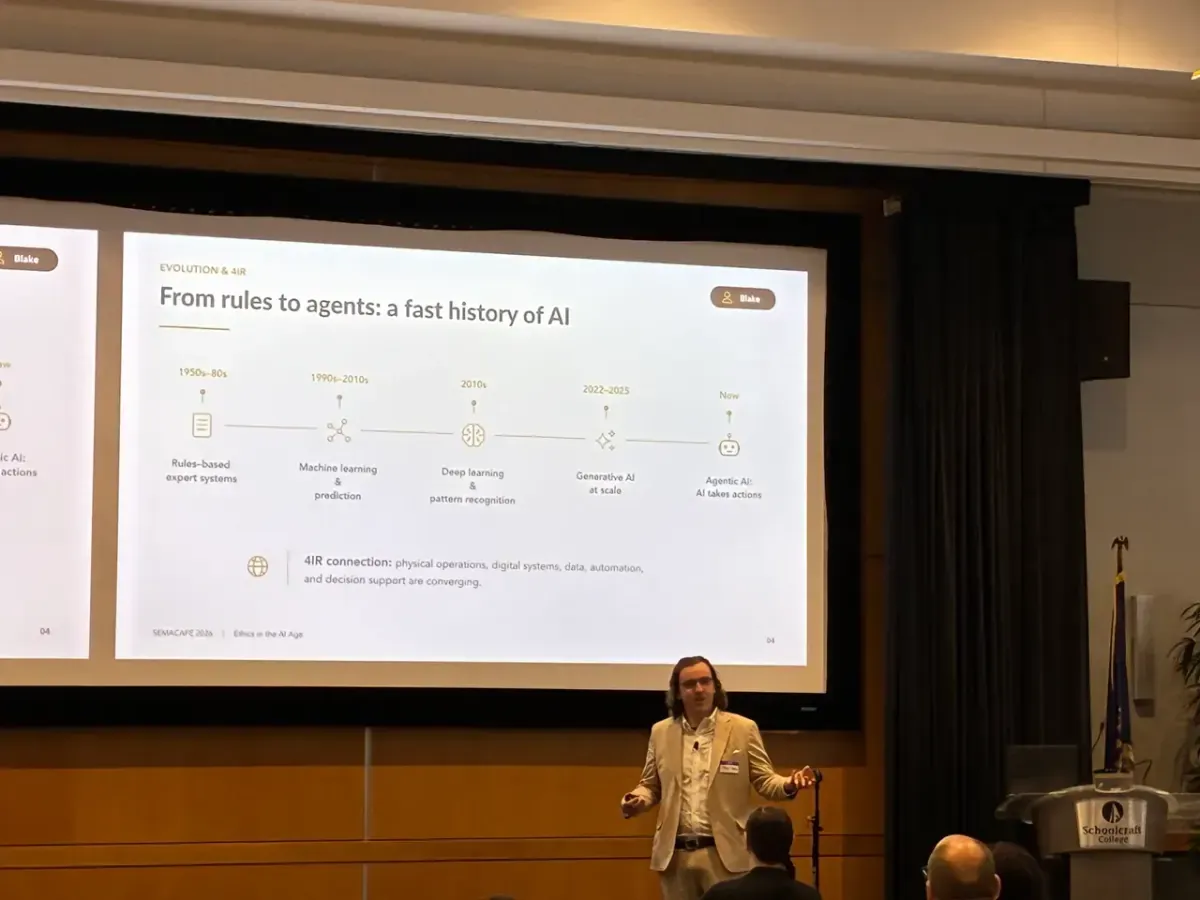
The timeline on screen — rules to agents.
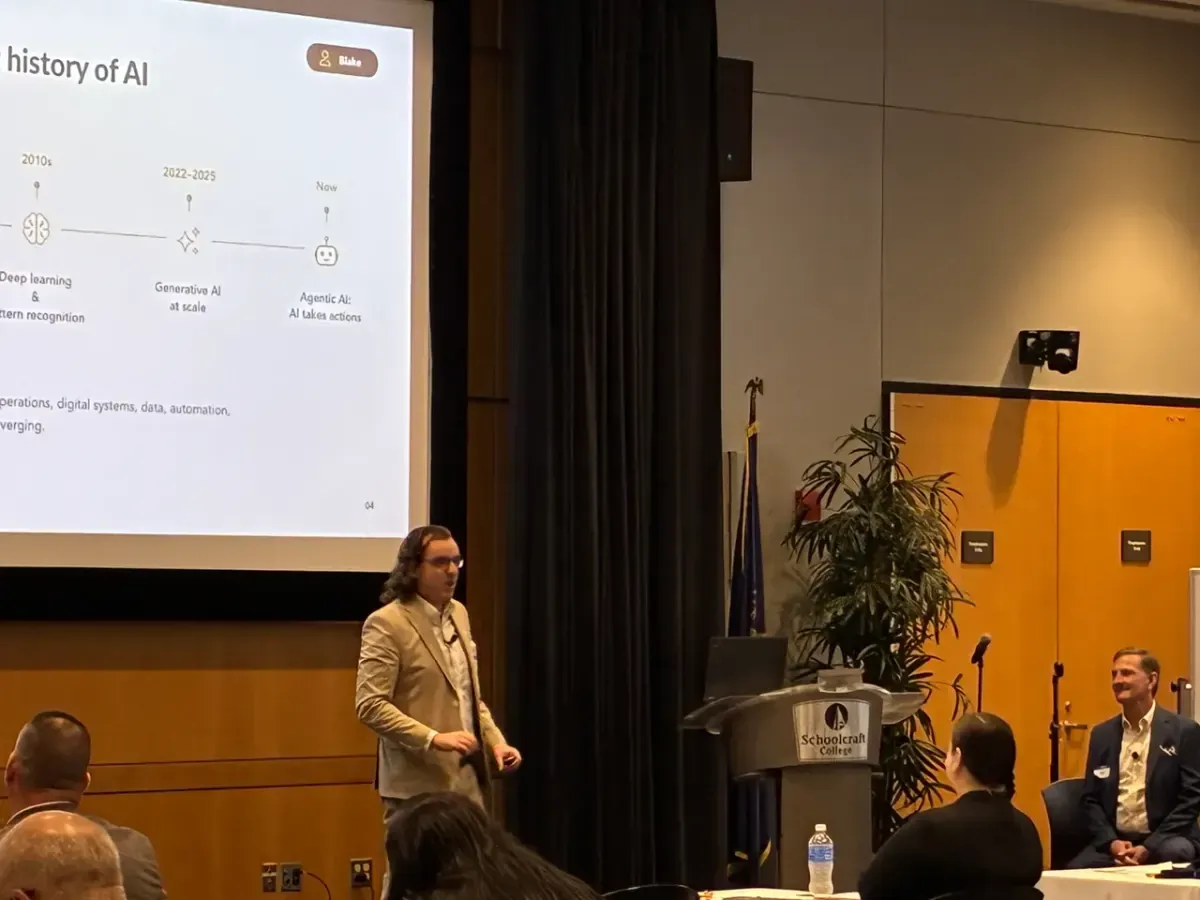
VisTaTech Center, Schoolcraft College.
The point is not to avoid AI
The job is to use the tool in a way the profession can defend — verify, document, and be ready to explain the method. That same evidence discipline shows up in work like grounding legal AI in real court data.
If you are building AI into fraud, audit, or advisory workflows and want a second set of eyes on controls and implementation, get in touch.