Case study
Explore an offline-first product buildBlogCESAIRoboticsVoice AIGenerative AINVIDIA
CES 2026: AI Has Left the Screen — and That Changes Everything
By Blake Oxford

AI Has Left the Screen
Less AI talking. More AI doing — embedded into real systems, real workflows, and the physical world.
Factories
Voice
Robotics
Simulation
Another great year at CES — and this one felt different.
CES 2026 made something unmistakably clear: we’ve entered the application era of AI. Not just software apps, but AI embedded into physical systems and real-world workflows.
Less AI talking on a screen. More AI actually doing things in the world.
From Demos to Deployment
What stood out most this year wasn’t flashy theory — it was practical, tangible use cases.
Siemens showed how LLMs can assist assembly-line workers in troubleshooting robotic failures. These aren’t hypothetical problems — they’re the kinds of issues that can shut down production for hours if not resolved quickly. Seeing AI applied directly to operational bottlenecks felt like a glimpse of where real value is being created.
SoundHound demonstrated deeply integrated voice AI across environments, from in-car systems to food ordering. We intentionally mixed Chinese and English in our prompts — a very real scenario for us — and the system handled transitions smoothly and naturally. That level of multilingual, contextual understanding is no longer experimental. It’s ready.
Generative AI Meets the Physical World
Beyond LLMs, generative AI is clearly moving off the screen and into physical form.
Wownow demoed a CNC device that turns generated images into engraved cards, coins, and small objects. Digital creativity, instantly transformed into something you can hold — consumer-ready and surprisingly delightful.
AOSeed showcased sketch-to-print 3D workflows designed for kids, creating an accessible, genuinely fun onramp to STEM. It was refreshing to see generative tools used to lower barriers, not raise them.
The Best Part of CES Is Still the People
What I appreciated most this year wasn’t just the tech — it was the people behind it.
As always, I spent a lot of time in the startup section, especially the international pavilions. That’s where CES really shines. You’re not talking to sales reps — you’re talking directly with founders, engineers, and builders who are thinking deeply about how these systems operate in practice, not just how they demo.
Smart, curious, grounded folks. I left many of those conversations excited to stay in touch and keep learning from them.
Humanoid Robotics: Less Sci-Fi, More Systems Engineering
Humanoid robotics was also fascinating to watch — not as spectacle, but as a convergence of AI, sensors, simulation, and real-world physics.
Seeing Boston Dynamics’ latest Atlas made it clear how far we’ve come. We’ve moved beyond carefully scripted motion toward systems that can adapt to balance, movement, and manipulation in dynamic environments.
What’s compelling isn’t just the form factor — it’s the tighter feedback loop between simulation and reality. These systems can now be trained and tested in simulated environments that closely mirror the real world, then deployed back into physical space. That loop — modeling, compute, reality, repeat — feels like a genuine inflection point.
NVIDIA Everywhere (As Usual)
A special thanks to NVIDIA — I was lucky enough to be pulled for a DGX Spark after completing their scavenger hunt, which turned out to be a great excuse to talk with a lot of incredibly interesting people along the way.
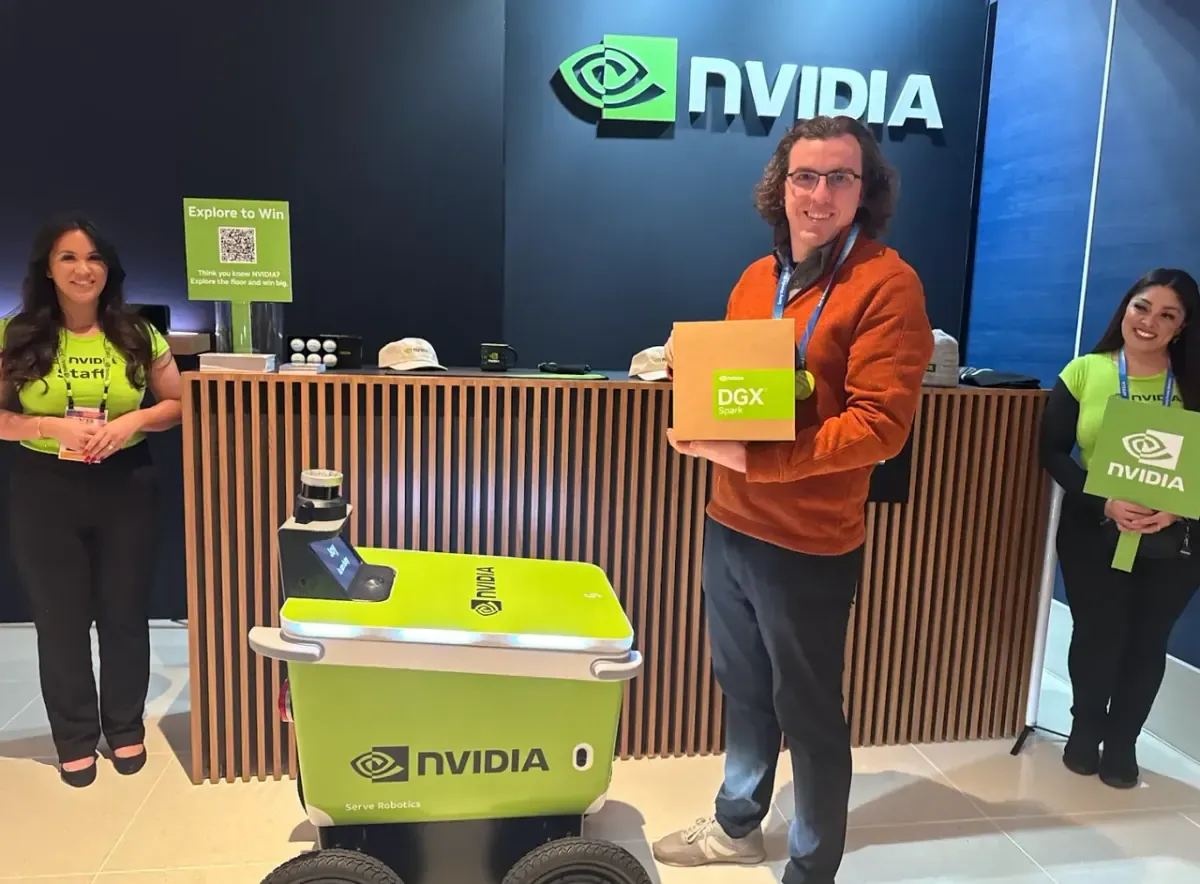
Those conversations spanned simulation, robotics, and the cutting edge of physical AI — and reinforced just how central NVIDIA’s platform has become in connecting massive compute to the real world. Their technology was everywhere at CES, often quietly powering what was on display.
I can’t wait to start building and experimenting with it.
Final Takeaway
CES 2026 made one thing clear:
AI has moved off the screen and into the real world — and the boundary between simulation and reality is getting thinner.
That’s where things start to get interesting.